Thermodynamic Bethe Ansatz for the Lieb-Liniger Model
The Lieb-Liniger model describes a one-dimensional gas of bosons with repulsive delta-function interactions:
where \(c > 0\) is the coupling constant. The thermodynamics of this model is exactly described by the Yang-Yang equation [YangYang1969]:
In this tutorial we solve this equation numerically using rapidity and compute thermodynamic quantities from the solution.
[1]:
import numpy as np
import matplotlib.pyplot as plt
from rapidity.core import Grid1D, Field
from rapidity.models import LiebLiniger
from rapidity.tba import TBAState
from rapidity.utils import plot

plt.style.use('seaborn-v0_8')
%matplotlib inline
Setting up the model
We define the Lieb-Liniger model with coupling constant \(c=1\) and set up a uniform grid.
[2]:
# define model
model = LiebLiniger(c=1.0)

# define rapidity grid
grid = Grid1D.uniform(-5, 5, 200, "theta")

print(f"Grid: {len(grid.points)} points")
print(f"Rapidity range: [{grid.points.min():.2f}, {grid.points.max():.2f}]")
Grid: 200 points
Rapidity range: [-5.00, 5.00]
Solving the TBA equation
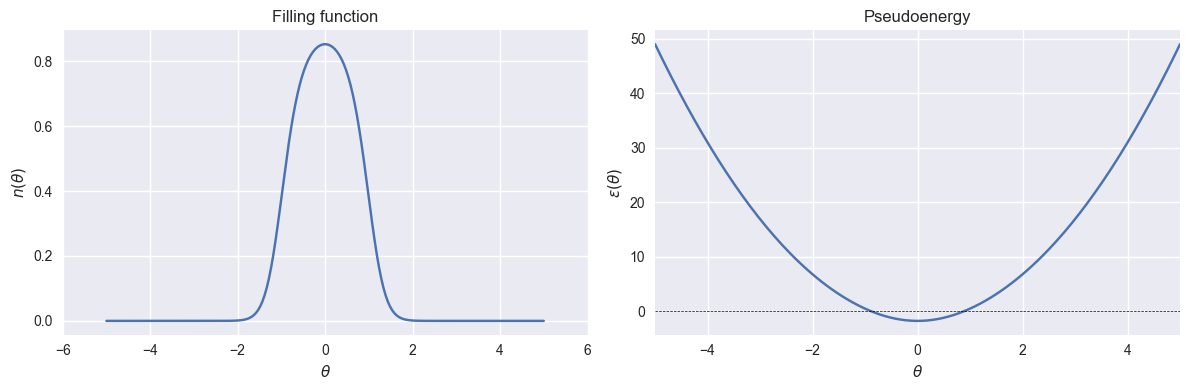
We solve the Yang-Yang equation at temperature \(T = 0.5\) and chemical potential \(\mu = 0.5\). The chemical potentials are passed as a dictionary keyed by charge order — charge 2 is the energy (\(\theta^2\)) and charge 0 is the particle number.
The inverse temperature \(\beta = 1/T\) multiplies the energy charge, and \(-\mu/T\) multiplies the particle number charge, giving the standard grand canonical driving term:
[3]:
T = 0.5
mu = 0.5

state = TBAState.from_betas(model, grid, betas={2: 1/T, 0: -mu/T})

# plot filling function
fig, axes = plt.subplots(1, 2, figsize=(12, 4))

#plot(state.filling, ax=axes[0])
axes[0].plot(grid.points, state.filling.values)
axes[0].set_xlabel(r'$\theta$')
axes[0].set_ylabel(r'$n(\theta)$')
axes[0].set_title('Filling function')
axes[0].set_xlim(-6, 6)

# plot pseudoenergy
epsilon = np.log((1 - state.filling.values) / state.filling.values)
axes[1].plot(grid.points, epsilon)
axes[1].set_xlabel(r'$\theta$')
axes[1].set_ylabel(r'$\epsilon(\theta)$')
axes[1].set_title('Pseudoenergy')
axes[1].set_xlim(-5, 5)
axes[1].axhline(0, color='k', linestyle='--', linewidth=0.5)

plt.tight_layout()
plt.show()
Thermodynamic quantities
From the filling function we can compute the particle density \(\rho_p(\theta)\), the state density \(\rho_s(\theta)\), and the effective velocity \(v^{eff}(\theta)\).
[4]:
rho_p = state.rho_p()
rho_s = state.rho_s()
v_eff = state.v_eff()

fig, axes = plt.subplots(1, 3, figsize=(15, 4))

axes[0].plot(grid.points, rho_p.values)
axes[0].set_xlabel(r'$\theta$')
axes[0].set_ylabel(r'$\rho_p(\theta)$')
axes[0].set_title('Particle density')
axes[0].set_xlim(-6, 6)

axes[1].plot(grid.points, rho_s.values)
axes[1].set_xlabel(r'$\theta$')
axes[1].set_ylabel(r'$\rho_s(\theta)$')
axes[1].set_title('State density')
axes[1].set_xlim(-6, 6)

axes[2].plot(grid.points, v_eff.values)
axes[2].set_xlabel(r'$\theta$')
axes[2].set_ylabel(r'$v^{eff}(\theta)$')
axes[2].set_title('Effective velocity')
axes[2].set_xlim(-6, 6)

plt.tight_layout()
plt.show()

# total density
N_L = rho_p.integrate().values
print(f"Total particle density N/L = {N_L:.6f}")
print(f"Free energy density f = {state.free_energy():.6f}")
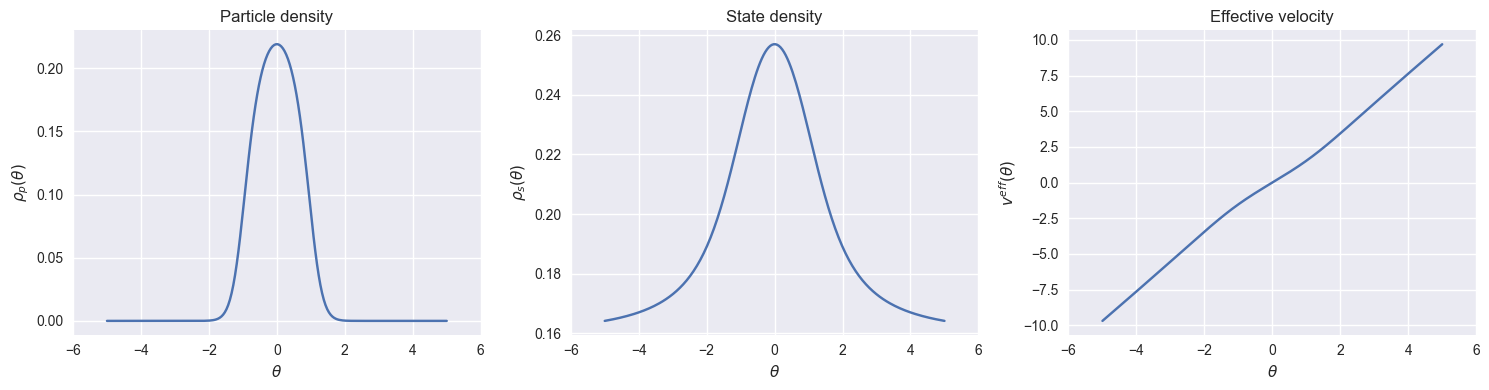
Total particle density N/L = 0.394173
Free energy density f = -0.464790
Temperature dependence
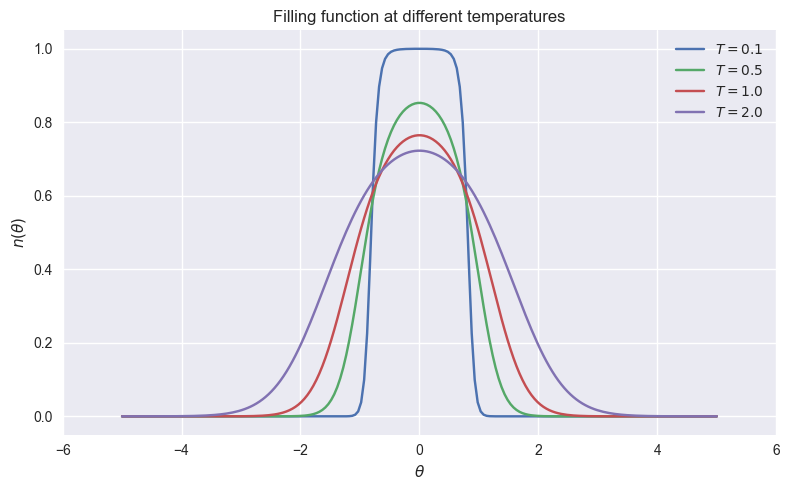
We now vary the temperature at fixed chemical potential and observe how the filling function evolves from the Fermi-Dirac distribution at high temperature to a step function at zero temperature.
[5]:
temperatures = [0.1, 0.5, 1.0, 2.0]
mu = 0.5

fig, ax = plt.subplots(figsize=(8, 5))

for T in temperatures:
    state = TBAState.from_betas(model, grid, betas={2: 1/T, 0: -mu/T})
    ax.plot(grid.points, state.filling.values, label=f'$T={T}$')

ax.set_xlabel(r'$\theta$')
ax.set_ylabel(r'$n(\theta)$')
ax.set_title('Filling function at different temperatures')
ax.set_xlim(-6, 6)
ax.legend()
plt.tight_layout()
plt.show()
Zero temperature limit
At zero temperature all states below the Fermi rapidity \(\theta_F\) are filled. We construct the zero temperature state directly using TBAState.zero_temperature, which uses a Gauss-Legendre grid on \([-\theta_F, \theta_F]\).
[6]:
theta_f = 2.0
state_T0 = TBAState.zero_temperature(model, theta_f=theta_f)

fig, axes = plt.subplots(1, 2, figsize=(12, 4))

axes[0].plot(state_T0.grid.points, state_T0.rho_p().values)
axes[0].set_xlabel(r'$\theta$')
axes[0].set_ylabel(r'$\rho_p(\theta)$')
axes[0].set_title(r'Particle density at $T=0$')

axes[1].plot(state_T0.grid.points, state_T0.v_eff().values)
axes[1].set_xlabel(r'$\theta$')
axes[1].set_ylabel(r'$v^{eff}(\theta)$')
axes[1].set_title(r'Effective velocity at $T=0$')

plt.tight_layout()
plt.show()

N_L = state_T0.rho_p().integrate().values
print(f"Total density N/L = {N_L:.6f}")
print(f"Fermi rapidity theta_F = {theta_f}")
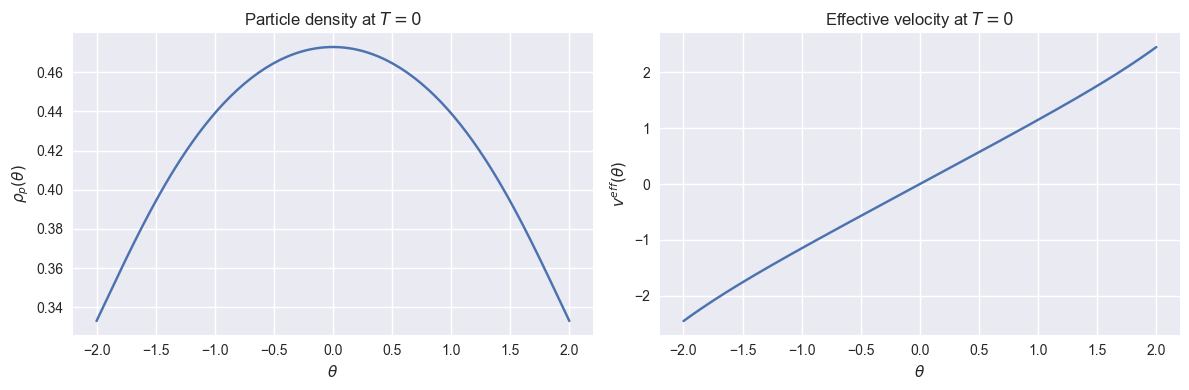
Total density N/L = 1.705870
Fermi rapidity theta_F = 2.0
Working at fixed density
In practice it is often more natural to specify the particle density \(N/L\) rather than the chemical potential. We use find_mu to find the chemical potential that reproduces the target density.
[7]:
from rapidity.thermodynamics import find_mu

target_density = 1.0
T = 0.5

mu = find_mu(model, grid, density=target_density, T=T)
state = TBAState.from_betas(model, grid, betas={2: 1/T, 0: -mu/T})

print(f"Target density: {target_density}")
print(f"Chemical potential: mu = {mu:.6f}")
print(f"Achieved density: {state.rho_p().integrate().values:.6f}")
Target density: 1.0
Chemical potential: mu = 1.472007
Achieved density: 1.000000
References
[YangYang1969] Yang, C. N., & Yang, C. P. (1969). Thermodynamics of a one-dimensional system of bosons with repulsive delta-function interaction. Journal of Mathematical Physics, 10(7), 1115-1122.
[Takahashi1999] Takahashi, M. (1999). Thermodynamics of One-Dimensional Solvable Models. Cambridge University Press.